
CNC Prototyping China Factory
The factory runs more than 80 production machines: 3-axis (50+), 4-axis (20+), and 5-axis (20+) milling centers, 25+ CNC lathes including mill-turn multi-task centers (Mazak / Brother class), and 7+ grinders (surface, centerless, cylindrical). A machine base this size matters for traceability in a specific way: it is a production floor, not a showroom, and every machine writes its data into the MES/ERP record. A part's history includes which machine ran it and when — the kind of detail a broker simply cannot produce.
| Equipment | Count | Tolerance |
|---|---|---|
| 3-axis milling | 50+ | ±0.003 mm (milling) |
| 4-axis milling | 20+ | |
| 5-axis milling | 20+ | |
| CNC turning | 25+ | ±0.002 mm |
| Precision grinding | 7+ | ±0.002 mm |
How does the traceability chain run through the factory?
The traceability chain is the factory's structural feature, not a marketing phrase. An integrated MES/ERP system records the raw material source and usage, process parameters, machine data, production batch, machining time, operator, and inspection data for every part. Incoming material is XRF-verified against its mill certificate at the door, and inspection data is attached to the batch before shipment. The result is a part that answers "what is this, who made it, and how do I make another" in a single connected record.
For you, this is the difference between a supplier who can isolate a problem to the exact affected parts and one who has to shut down a line while it guesses. The same discipline runs on every job, not just the automotive ones that formally require it.
Which certifications and capabilities define the factory?
Three certificates are held, with scope stated honestly. They are the floor, not the ceiling — a certificate proves the system has been audited; the traceability chain and the CMM reports prove the part.
| Standard | Certificate number | Scope |
|---|---|---|
| ISO 9001:2015 | 116024/A/0001/UK/En | Machining of metal parts |
| IATF 16949:2016 | 131941/A/0001/SM/En | Manufacture of CNC metal machining parts (excludes product design, Clause 8.3) |
| ISO 14001:2015 | 116024/B/0001/UK/En | Environmental management related to machining of metal parts |
Process capabilities cover turning, milling, mill-turn, grinding, and outsourced heat treatment and surface finishing. Materials span plastics, aluminum, stainless steel, brass, copper, titanium, and magnesium alloys. Industries served are automotive, robotics, electronics, medical, and automation machinery and equipment.
What are the MOQ and lead times at this factory?
There is no forced production minimum. The MOQ is 1 piece, so a design can be prototyped, validated, and iterated before volume. Lead time is set by part complexity and the number of process steps — roughly 3, 7, or 30 days — rather than by a blanket promise. Complex parts can run 10–20 process steps, and surface finishing pushes a part into the longer tier.
Why does factory ownership matter when sourcing a prototype?
A factory and a broker can both ship you a part, but only one can hand you the process that made it. When the prototype and the production run happen in the same facility, the programs, fixtures, process knowledge, and metrology baseline carry over — you qualify a part once. When they happen in different shops, you qualify twice, and the second qualification is paid for in scrap and delay. The factory's traceability chain is what makes that handoff real rather than rhetorical: the record that qualified the prototype becomes the reference for the production run.
What do the machine brands tell a buyer about a floor?
A machine brand is shorthand for what a floor can be held accountable to. A named make — Mazak, Brother, TSUGAMI, Sodick, plus Citizen and Star on the turning side — means a documented, serviceable asset with a known controller and a spare-parts channel. A "CNC machine" with no name means none of that can be verified. The brand is not a style choice; it is the difference between an asset you can audit and a claim you have to take on faith.
The brand also signals repeatability. Machines of a known make run to published specifications, so the tolerance a shop claims is checkable against the machine's own capability, not just the shop's assertion. When the part's record names the machine, and that machine is a known brand, you can trust the entry, because the entry points at a real, serviceable asset.
| Brand family | Typical role on a floor | Why it matters to a buyer |
|---|---|---|
| Mazak / Brother | Milling and mill-turn centers | Known controllers, documented capability |
| TSUGAMI / Citizen / Star | Production and Swiss-style turning | High-precision round work |
| Sodick | Precision and EDM-class work | Fine features and hard materials |
How do you read a machine list — why counts and brands matter for process repeatability?
A machine list is the floor's capability statement. Counts tell you capacity: can the shop absorb your run without disrupting someone else's, and is there a second machine of the same type if one goes down. Brands tell you repeatability: are the assets documented, serviceable, and run to known specifications. A list that states both — models and counts — is a floor. A list that states neither is a brochure.
The traceability link is direct. A specific machine is a field in the part's record, so a floor that cannot name its machines is a floor that cannot complete the record. Redundancy matters here too: with more than 80 production machines across categories — 3-axis (50+), 4-axis (20+), 5-axis (20+), 25+ lathes, 7+ grinders — if one asset drifts, work moves to a sibling and the drift is isolated, not absorbed into a bottleneck. Ask for the list broken down by axis count and process; a real floor has it memorized because it runs it daily.
What does a factory visit or audit verify, step by step?
A visit is the traceability chain observed rather than claimed. Four stations are worth the walk, and each answers a question no email can.
- Receiving. Ask to see the XRF and the mill certificates side by side. If the alloy check happens at the door, you can watch it happen.
- The floor. Watch a job run, then ask which record it is writing. A live job should have a live record, not a promise of one.
- Inspection. Ask for a current CMM result, not a sample pulled from a drawer. The report should carry today's batch number.
- The system. Ask to see the MES/ERP record for one part, end to end — material, process, machine, batch, operator, inspection.
The visit answers the question that separates a system from a performance: does the chain run when nobody is watching? A supplier that invites the audit and lets you see all four stations is showing you a process. A supplier that demurs on any one of them is showing you the seam.
How does the facility layout support the chain?
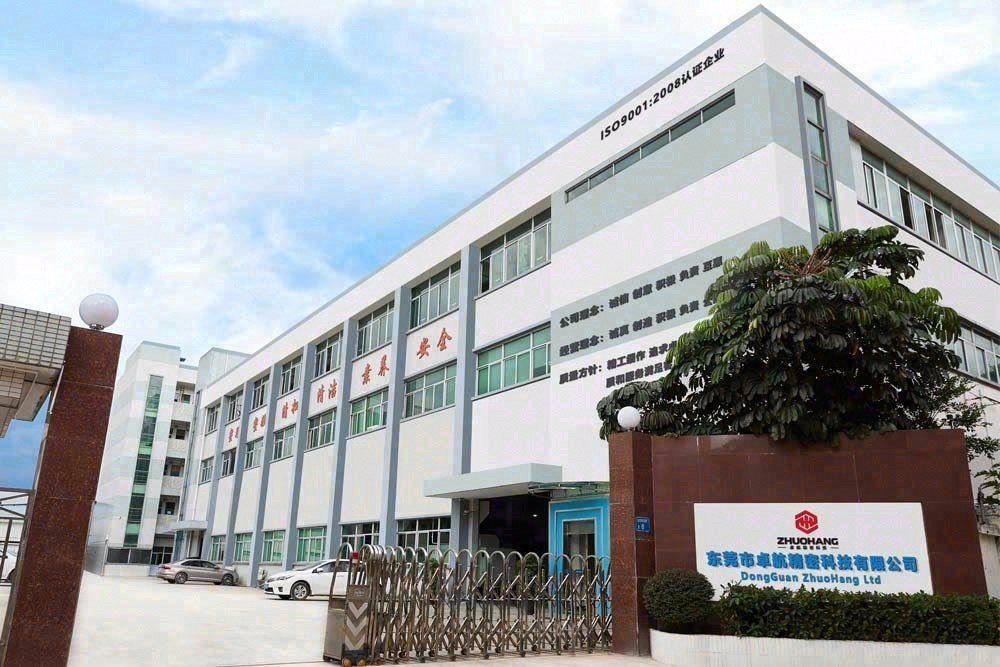
The campus is 6,800 m² across two buildings: production, inspection, and offices in one; staff dormitories and dining in the other. The layout matters for one reason — inspection sits next to production, so a part moves from machine to CMM without leaving the record's sight. A part that never leaves the building is a part whose chain never crosses a subcontractor boundary.
Single-campus structure means fewer seams. Every outsourced step is a handoff where process knowledge can be lost and where "who made this and how" gets harder to answer. Keeping metal-cutting, inspection, and the people who run both on one campus keeps the chain short and unbroken. That is a physical fact you can see on a visit, not a claim you have to accept.
What legal and registration documents should you cros-check?
Before you order, three documents should line up, and each is independently verifiable. The registration number (91441900MA4UWT6X39) identifies the legal entity. The address on the certificates — No. 8, Shuibian Songyuan Road, Hengli Town, Dongguan, Guangdong, China 523470 — should match the address the registrar holds. The three certificate numbers (ISO 9001:2015, IATF 16949:2016, ISO 14001:2015) should be current with the issuing body.
The name on the contract matters too. "CNC Prototyping China" is the trading name; the contract, the certificates, and the traceability records all carry the legal name, Dongguan Zhuohang Ltd If you verify the entity, the address, and the certificates before ordering, you have removed the biggest source of supplier ambiguity — who you are actually contracting with. That is the first link in any traceability chain, and it sits on paper before any metal is cut.
What this shop actually runs
We machine every part in our own 6,800 m² plant in Dongguan, China, on 100+ CNC machines with 100+ staff. The machine list by category:
- 5-axis machining centres (10+) - Mazak VARIAXIS I-600 (510/910/510 mm travel, 12,000 rpm, 22 kW, 71.6 N·m, 30-tool BT40) and Mazak INTEGREX I-250H S (B-axis 0.0001°, 24 kW, 124 N·m, 38-tool HSK-A63). Dedicated to compound-angle parts, single-setup multi-face prismatic work, and aerospace fittings where datum transfer loss is unacceptable.
- 3-axis / 4-axis machining centres (50+) - Brother SPEEDIO S500Z2N / S700Z2N (10,000 rpm, 14/21-tool ATC, 0.7 s tool-to-tool, Z-axis 2.2 G) and Mazak VCE-430A L / VCE-570C L (10,000 rpm, 118 N·m, 24-tool ATC). Dedicated to prismatic parts, plates, brackets, housings.
- Swiss-type turning centres (10+) - Citizen Cincom A20-3F7 (Φ20 mm, 10,000 rpm), TSUGAMI B0206-III / B0205-III (Φ20 mm, 0.1 µm), STAR SR-32JII / SR-32J Type N (Φ32 mm, 8,000 rpm). Dedicated to long, slender rotational parts at ±0.002 mm.
- CNC turning centres (20+) - HEADMAN T70M/1250 (720 mm swing, 117 mm bore, 3,000 rpm, BMT75 12-station turret). Dedicated to shafts, bushings, flanges up to ±0.002 mm.
- Wire EDM (5+) - Sodick AQ535L (550/350/300 mm travel, ±20° taper, 800 kg workpiece). Dedicated to hardened tool steel, internal splines, sharp internal corners that milling cannot reach.
- Inspection: Hexagon CMM + 20+ gauges - Hexagon CMM for coordinate measurement, plus vision system, profilometer, hardness tester, coating thickness gauge, XRF for material verification. The 10:1 rule (gauge 10x more accurate than the band) is applied to every feature.
- Machine highlights - VARIAXIS I-600: one-setup multi-face 5-axis + MAZA-CHECK auto-calibration; INTEGREX I-250H S: DONE-IN-ONE mill-turn, B-axis 0.0001° + Ai thermal shield; SPEEDIO S500Z2N / S700Z2N: Z-axis 2.2 G + 0.7 s ATC; Swiss-type: guide-bush switchable + 0.1 µm resolution.
Tolerance: ±0.003 mm CNC milling / ±0.002 mm CNC turning / ±0.002 mm grinding and wire EDM. Capability: Ppk >= 1.67 initial on key characteristics, Cpk >= 1.33 ongoing.
Certificates: ISO 9001:2015 (116024/A/0001/UK/En), IATF 16949:2016 (131941/A/0001/SM/En, with design clause 8.3 excluded, stated openly) and ISO 14001:2015 (116024/B/0001/UK/En), issued to Dongguan Zhuohang Ltd, registration 91441900MA4UWT6X39, founded 2005.
Where we ship: Austria, Belgium, the Czech Republic, Denmark, France, Germany, Greece, Hungary, Ireland, Italy, the Netherlands, Spain, Sweden and the United Kingdom in Europe; Brazil, Canada, Mexico and the United States in the Americas; China, Israel, Japan, Singapore and Sri Lanka in Asia; Australia and New Zealand in Oceania; and South Africa in Africa — plus other countries and regions worldwide, shipped from our base in Dongguan, China.
Contact: Felipe Iglesias, [email protected], +86 13126536955.
Ready to source from a factory you can trace?
Send your drawing to [email protected] or call +86 13126536955, or arrange a factory visit and audit.
Frequently Asked Questions
Who is the legal entity behind CNC Prototyping China?
In short, Dongguan Zhuohang Ltd, also known as Zhuohang Precision Machining Factory and Dongguan Zhuohang Precision Technology Co., Ltd., founded in 2005 and headquartered in Hengli Town, Dongguan, Guangdong, China. The facility covers 6,800 m² with more than 100 employees.
Where is the factory located?
No. 8, Shuibian Songyuan Road, Hengli Town, Dongguan, Guangdong, China 523470. The campus has two buildings: one for production, inspection, and offices, and one for staff dormitories and dining.
How many machines does the factory run?
More than 80 production machines — 3-axis (50+), 4-axis (20+), 5-axis (20+), 25+ lathes, and 7+ grinders — plus more than 20 inspection instruments including Hexagon CMMs.
What is the traceability capability of the factory?
An integrated MES/ERP system links every part to its material lot, process parameters, machine data, production batch, machining time, operator, and inspection results — the full material-to-part traceability chain.
Which certifications does the factory hold?
ISO 9001:2015 (116024/A/0001/UK/En), IATF 16949:2016 (131941/A/0001/SM/En), and ISO 14001:2015 (116024/B/0001/UK/En). IATF 16949 scope excludes product design under Clause 8.3.
Which industries does the factory serve?
Automotive, robotics, electronics, medical, and automation machinery and equipment — the component fields where dimensional accuracy and traceability are the entry ticket, not a differentiator.
What is the minimum order quantity?
Our MOQ is 1 piece. We take prototype and single-part orders as well as production runs, so you can validate a part before committing to volume.
How do I visit or contact the factory?
Contact [email protected] or +86 13126536955 to arrange a visit or audit. The facility is open to factory visits and audits.
What machine brands run on the floor, and why does it matter?
In short, Named makes including Mazak, Brother, TSUGAMI, and Sodick, with Citizen and Star on the turning side. A named brand means a documented, serviceable asset with a known controller, so the tolerance claim is checkable against the machine's own capability.
What does a factory visit verify?
Receiving (XRF against the mill certificate), the floor (a live job and its live record), inspection (a current CMM result), and the MES/ERP record for one part end to end. The visit confirms the chain runs when nobody is watching.
Continue reading: CNC Prototyping China Services · CNC Prototyping China · CNC Prototyping China Parts Manufacturer
Standards referenced on this page
- IATF 16949:2016 — Automotive quality management system standard
- ASTM A582/A582M-12 — Standard Specification for Free-Machining Stainless Steel Bars
- ISO 14001 — Environmental management systems — Requirements with guidance for use
Business conduct and due diligence
We operate in full compliance with all applicable laws and regulations. Suppliers are paid on agreed terms and wages are paid in full and on time. Every full-time employee receives the statutory benefits required by law. We support local community development through charitable donations.
Our legal and regulatory record is publicly verifiable in China, with no material litigation or enforcement action involving customers, suppliers, employees, authorities, or other third parties. Buyer-side due diligence is welcome.